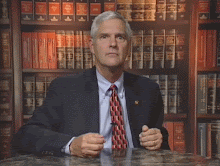
“FREE TO CHOOSE” IS THE SLOGAN FOR PROSPERITY - by Judge Jim Gray 01/06/08
We are about to enter another New Year. May it meet your (reasonable) expectations, and may you prosper.
Okay, that is the formality, but I actually hope it comes to pass. Nevertheless, for us to maximize everyone’s chances of fulfilling those desires for prosperity, we must listen better to that great thinker and Nobel Prize-winning economist Dr. Milton Friedman and his equally brilliant wife Rose.
Yes, we as citizens and voters actually have to consider economics, because this is the “invisible hand” that in so many ways drives our decision-making process and also that of our great nation as well. And the basis for our prosperity is simple: the basis is “choice,” or as the Friedmans put it in the title of the economic bible they wrote, we must be “Free to Choose.”
What does that mean? It means that the foundations of prosperity based upon our free choice are private property rights, a fair and foreseeable system of justice, and entrepreneurship and all of the calculated economic risk-taking that this entails.
This sounds like intellectual egg-head talk, but it really is not. It simply means that we must set up a system that maximizes ways people can choose for themselves how to work and spend their money, instead of having the government make those choices for them. This necessarily means that people will benefit from the good choices they make and be responsible for poor ones. But that is the way to prosperity. Therefore, every time the government substitutes its “wisdom” for ours, it is taking us farther away from prosperity.
For example, if you feel you get good value for your money by having a particular person cut your hair, why should the government require a license before that person can do that work? Remember, if the work is not worth the money charged, the would-be barber will go out of business regardless of what the government license says.
Of course we will still need things like protections against environmental pollution and recourse for defective or even harmful products. But fortunately in most ways the justice system can handle those issues.
So how do property rights fit into this discussion? Let me give you an example. Consider that there was a grove of apple trees growing wild somewhere along the Oregon Trail during the covered wagon days. So when a wagon train would come upon it, the travelers would pick more of the ripe apples than they needed – why not, they’re free?
Then the people in the next train would probably pick all of the remaining ripe apples, and most of the green ones as well. Why not, they’re free, and the travelers can always feed the unripe apples to their oxen. So soon there would be no more apples at all on the trees. But the people in the next train would cut down the branches and even the trunks of the trees to use as firewood. Why not? They can use the wood, and if they do not cut it down, someone else behind them will.
Therefore, in this situation not only would no one plant, feed and prune the trees and harvest the apples for maximum benefit, the trees would actually be plundered and soon destroyed. But if a private person had enforceable ownership rights to the apple grove, enforced by a fair and foreseeable system of justice, there would very likely be an abundance of apples for all.
In other words, with enforceable property rights, people have the incentive to work hard and plan for the long run future because they will profit from their efforts. But without those property rights, the incentives instead are for people to plunder the resources in the short run before someone else does so.
Now to take this discussion one step farther, who has more incentive to plant, organize and develop a better apple grove, private people working for their own self-interest, or the government? For the answer to that question, ask the people of Poland, the Czech Republic or Cuba. Or compare the productivity level of South as opposed to North Korea, or previously West Germany as opposed to East Germany. Furthermore, what is a better way to decide how many washing machines to manufacture, or how many black cars to produce instead of red cars? To have a government bureaucrat make the decision, or a private company that is sensitive to the free market choices of its customers?
To have a system of government decisions in the marketplace leads to what the Friedmans call the “tyranny of control.” And bureaucrats always have a natural tendency to increase their power and their area of influence. That is a major explanation for our government being so large and controlling today. But to have the decisions made privately brings the most rational decisions in manufacturing and distribution. And that brings prosperity!
So let us keep in mind and adhere to the teachings of the Friedmans. The free market actually works! All a country needs to be prosperous is a vigorous system of entrepreneurship – not natural resources (Look at Japan!) or even access to the latest technology (Look at Botswana!).
And if you still disagree with this statement, let me clinch it by asking you a few of Milton Friedman’s questions: “Why do you believe that political self-interest works better than economic self-interest? Or why do you believe that government bureaucrats can make more rational choices for you than you can? (And by the way, if the government accumulates more power, the industrialists and other private interests will simply take it over and control it anyway.)
So when will we find these governmental “angels of the public good” to better organize our society? And why haven’t we found them yet? The plain reality is, as stated by the Friedmans, that all societies run on greed, but the prosperous societies run on individuals that run on their personal interests. Competition under a fair and foreseeable justice system pushes us to advance and, once again this brings prosperity.
Look at the recent experiences in Ireland and New Zealand, where large cuts in taxes and government spending directly resulted in substantial increases in investment and entrepreneurship. This has also been seen in Botswana, which has in a short time progressed from one of Africa’s poorest nations into one of middle-range income. The truth is that no peoples have broken away from poverty except under a system of capitalism and free trade, and that means free economic choice. (Today’s China is another case in point.) The big problems come when foreign aid and government interference undercut the local entrepreneurship.
As a result, our efforts at foreign aid would be ever much more successful in non-emergency situations if we would make small business loans of money or even farm animals to the people at the bottom of the economic ladder, instead of providing loans of money and products directly to foreign governments. The former are used by the people to set up and expand local businesses, which create prosperity; the latter are most often used by politicians to purchase expensive automobiles and end up in Swiss bank accounts.
So I believe the Friedmans would conclude this discussion by saying that there are four ways to spend money. The first is that you will spend your own money on yourself. That will be done carefully, and you probably will get your money’s worth. The second is you will spend your money on someone else. Then you will mostly get your money’s worth, but you will be careful not to spend too much. The third is you can spend someone else’s money on yourself. There you will probably get fairly good deals on things you mostly do not need. And fourth, you can spend someone else’s money on someone else. There you will get our nation’s public school system, which we will discuss in a future column.
There certainly is a need for a federal government, but that need is generally just for a strong military, national court system and police network, system of currency, and matters of foreign relations. For other government roles we should go back to the concept of Federalism – which made our country great! That means that the most local government that is able effectively to address a particular issue would have the authority and power to do so. Finally, as it states in both the 9th and 10th Amendments to the U.S. Constitution, the rest of the powers should be reserved for the people themselves. And, as the Friedmans would quickly say, that would allow the people to be Free to Choose.
So as the New Year is upon us, let us come together and decide to change away from a bigger and ever more encroaching government. And we can do it simply by asking ourselves when it comes time to vote which candidates or propositions would more encourage free choice for the most people and responsibility for the choices made?
So now armed with the slogan “Free to Choose,” I sincerely wish you all a Prosperous New Year!
James P. Gray is a Judge of the Superior Court in California, the author of Why Our Drug Laws Have Failed and What We Can Do About It - A Judicial Indictment of the War on Drugs (Temple University Press, 2001) and Wearing The Robe - The Art And Responsibilities of Judging In Today's Courts, has a blog at http://judgejamesgray.blogspot.com/. http://www.judgejimgray.com, and can be contacted at www.judgejimgray.com.



+a.jpg)