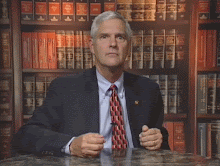
When I was a judge on the mental health calendar, one of my happiest collateral duties was to officiate over three adoptions almost every morning, and I tried to make them the truly special occasions that they were.
So, among other things, if there were grandparents in attendance, I had them raise their hands and be sworn, right along with the parents, saying that they had duties to perform as well. Then after complying with the law and having the parents swear to support the children and treat them just as if they were their natural birth children, I also figuratively had the grandparents swear that they would spoil the grandchildren. And I never had a complaint. (For example, of course, the child can have a chocolate chip cookie before dinner, etc.)
Being a grandparent is a wonderful thing. Yes, when the children are messy or misbehaving, they can mostly be returned to the parents, and that can be nice. But much more importantly, the relationship between children and grandparents is truly special.
In fact, grandparents can play a unique role, providing unconditional love, helping to make children aware of their roots, providing values to grow from, cultivating a respect for age and wisdom, providing important role models, and inserting another important person in their lives that children would not want to disappoint with bad behavior.
As a result, grandparents can be important mentors, confidants, elder statesmen, playmates and friends. And because we grew up in a more patient time, when you dialed a telephone number and had to wait for the dial to return back to its resting place, we can bring more of that sense of peace to the children. Of course, grandparents must remember not to contradict the parents, and (mostly) to follow the parents’ rules. But otherwise, the sky is the limit.
So I offer some suggestions about how to make this opportunity the best it can be. And please don’t be bashful in sharing some of your own suggestions on the subject with the rest of us at dailypilot.com. That way we all can better take advantage of this wonderful opportunity!
Naturally, the first recommendation is to do things with your grandchildren — almost anything. The zoo, the beach, the park, shopping, a baseball game, the county fair and so much more. In fact, I have always anticipated that the best way of going to Disneyland would be to take my grandchildren and simply sit back and watch them enjoy the experience. What a contemplation! And sometimes you will want to take just one of your grandchildren alone. It is really fun to be able to have a concentrated experience with just one at a time.
Actually, reading to and with them can be just as much fun and a bonding experience as an excursion. You can share adventures together, laugh at silliness, pull for heroes, and scoff at villains. Then after you have finished, you can have great discussions about the stories you read, and how they might feel or act had they been one of the characters.
My favorites are reading Frank Baum’s “The Wizard of Oz” books to them, or reading Dr. Seuss’ “Fox in Sox” with them. Doing this will make long-term and wonderful memories — you can count on it. And along the way you will be exposing these youngsters to a truly joyous and mind-expanding world. (And seriously improving their eventual SAT scores by helping them to develop their language skills and reading comprehension!)
You can also help to create some other truly fun and teachable moments with your grandchildren, virtually all of whom have brains like sponges. For example, borrow a practice used by Newsweek and inspired from Smith Magazine’s Six-Word Memoir Project, by choosing a topic of interest to them and then having them describe their thoughts about it in only six words.
But be sure to give them extra time to think about and refine their selection of words. It can be highly instructive, enable them to show their own particular creativity, and also be lots of fun. This also has the benefit of being able to be done when traveling in a car, or virtually anywhere else.
Another fun and instructive thing to do is to have them find something useful in the home that we take for granted, and write a few paragraphs about how that thing works.
For example, you might have them inspect a toilet, and then write about how it works. Then they can first read what they have written out loud, but in the same boring way that most children read. Then have them read it again, but this time with real and even exaggerated feeling. One approach is to tell them to act as if they know something that will really interest or help their listeners, and be anxious to pass it along to them. You will see that not only the kids will have lots of fun with these projects, but they will learn a lot from them as well.
Similarly, you can play a DVD movie or sitcom for them, or read a play or short story together, and then stop about two-thirds of the way through it and ask them to create their own ending for the story.
Then sit back and watch their creativity blossom. After this has been done, you can all watch or read the actual ending to the story and discuss which ending is better. Most times, of course, you will state — to the grandchildren’s eternal delight — that their endings are better.
Furthermore, in having your grandchildren participate in all of these activities, you will also be giving them the gift of speaking and expressing themselves in public. The more they do it, the smoother and more comfortable they will be — then and for the rest of their lives. And if you give small prizes for the most creative, enthusiastic, realistic, etc. (being sure to spread the prizes around to each of the participants), you will stimulate them to even greater heights.
When I composed my high school musical entitled “Americans All,” I involved the students in doing things like this, and called it “Project Project.” In other words, each student was to try to develop the reputation that, for example, if people knew that Linda would be doing a particular project, they would know that it would be done right, whether it was drawing a picture, taking someone on a tour of their school, or reading a story out loud. In other words, they would “eschew mediocrity,” and instead always pursue excellence. Other than the children’s parents, grandparents are in the best position to promote this concept.
As I am sure you have seen yourself, children do not grow up in reverse. Once your children have grown and gone, they can become your friends — in fact your really good friends, with natural common bonds and experiences.
But now that they are grown, and you are more experienced, and you have more resources, wisdom, and time, you could be blessed to get to do it all over again in being a grandparent. So don’t let this golden opportunity slip by. Because at this point in our lives, being a grandparent really can be what “the good life” is all about!
JAMES P. GRAY is a retired judge of the Orange County Superior Court, the author of Wearing the Robe – the Art and Responsibilities of Judging in Today’s Courts (Square One Press, 2008), and can be contacted at jimpgray@sbcglobal.net or via his website at www.judgejimgray.com .
Showing posts with label Americans All. Show all posts
Showing posts with label Americans All. Show all posts
Sunday, October 4, 2009


Monday, December 1, 2008
Synopsis of the musical “Americans All” by Judge Jim Gray
SYNOPSIS OF “AMERICANS ALL” - by Judge Jim Gray 08/26/07
After the Overture, Act I, Scene I is set in the kitchen or family room of a male high school teacher’s house on the first day of school. Teacher and his wife discuss the upcoming day in which the teacher wants to help his students expand their horizons and live fuller lives. He explains by singing “How Can I Help Them to Be?”
Act I, Scene II in the high school classroom with all of the students present but before the arrival of teacher. The basketball jock talks with his classmates about how unimportant an education is because he is going to “make it” in basketball. He explains by singing the rap song “Who Cares?” and is joined by his classmates. But he is also joined in the number by “Smart Guy,” who is a nerdish student who loves to learn, and he recites the accomplishments of the U.S. presidents in chronological order.
Then teacher enters the classroom, and while talking sees a student drop some trash on the floor. This action is converted into the song “Pick It Up” by the teacher and the class, which not only discusses picking up the trash in one’s life, but also your spirits, your attitude and even your friends. After this a “lady’s man” or “man’s woman” tells the teacher that it is fine to “eschew mediocrity” and things like that, but what really gets the eye of the ladies or the men is how you walk and talk and how you strut your stuff, which turns into the song “You Gotta Have Style,” which is joined by the class and the teacher, who also shows the class that your style is inside, and that it is stylish to work, etc.
One other student then sings the song “Do You Know Their Names?” which addresses the numbers of people in our society who are custodians, wait on our tables or have mental disabilities, and who blend into the background and are ignored. Then, while the teacher is spreading his “pearls of wisdom,” two students drift to stage left and stage right and daydream about their future, singing the song “Every Day.” The female student dreams about her future and how she will be able to make her life “count,” but in the meantime feels all alone. The male student dreams about finding someone, because inside he is handsome and he is strong, but until he finds her he also feels all alone.
To end the first act, the teacher sings the lesson that “It Just Takes One” with regard to things like finding a college, finding a profession and finding a mate. And also it just takes one bad move to lose your life or critically injure yourself or others. Act I culminates with the song “The Dream Lives On,” and which reprises the song “Every Day,” in which the entire class sings that if you are a real friend, you are never really alone.
After the Overture, Act II opens once again in the teacher’s house, where the wife feels her husband is so wrapped up in his students that she is being ignored. Teacher is concerned and asks for a further explanation. So wife sings “Love Is Not Enough,” in which she says that it is not enough just to have your love, what I really need is you. This song gets teacher’s attention, and ends with them both singing about the importance of family, and then further evolves into teacher singing about his love for his wife in the song “It’s Been a Long Long Way to You.”
Act II, Scene 2 addresses the class’ project of “Project Pro-ject,” in which the class is required to demonstrate the concept that anything that is worth doing is worth doing well. It begins with one student reading about a history of a flush toilet in the stammering and boring way that most students read. Then the second student “pro-jects” by reading the same passage with enthusiasm and interest.
At this point, the class gets into an assignment to sing about the concept of peace in different countries and cultures around the world. First a student sings a song about things that take away from peace in a song entitled “Hate Spoils the Sauce.” Then students from a Mexican, then Jewish and then Arab heritages sing about the concept of peace in songs entitled “Viva El Trabajo y la Paz,” “Live, Love, Laugh, Shalom!” and “Salam,” and as the last of these songs is ending, all of these students join together in a folkdance, arm in arm.
At this point, Smart Guy gives a presentation about the importance of staying in school and getting an education. Among other things, people will pay themselves over the course of their lifetimes a minimum of $117 per hour for every hour spent in high school if they only stay in school long enough to graduate, and then that pay more than doubles if they get a college degree! At this point the class realizes that it is “Smart Guy’s” birthday, and join in singing their salutations to him/her in the song “Happy Happy Birthday.”
Project Pro-ject draws to a close as part of the class sets forth the type of life they want to live in a poem entitled “Cast A Glance Around You.” Then teacher steps forward and talks to the class about how so many people in our world have become “victims,” and accents that by having the class join him in the song “Playin’ the Blame Game.”
The class ends with all of the students singing a song that some of them have written about what it is to be an American in the song entitled “We Call Ourselves Americans.” That is followed by a curtain call, with the participants taking their bows while the cast sings a short passage from the songs that they sang, and then comes the Finale, as the entire ensemble sings the song “Americans All.” http://www.judgejimgray.com/americansall.php
After the Overture, Act I, Scene I is set in the kitchen or family room of a male high school teacher’s house on the first day of school. Teacher and his wife discuss the upcoming day in which the teacher wants to help his students expand their horizons and live fuller lives. He explains by singing “How Can I Help Them to Be?”
Act I, Scene II in the high school classroom with all of the students present but before the arrival of teacher. The basketball jock talks with his classmates about how unimportant an education is because he is going to “make it” in basketball. He explains by singing the rap song “Who Cares?” and is joined by his classmates. But he is also joined in the number by “Smart Guy,” who is a nerdish student who loves to learn, and he recites the accomplishments of the U.S. presidents in chronological order.
Then teacher enters the classroom, and while talking sees a student drop some trash on the floor. This action is converted into the song “Pick It Up” by the teacher and the class, which not only discusses picking up the trash in one’s life, but also your spirits, your attitude and even your friends. After this a “lady’s man” or “man’s woman” tells the teacher that it is fine to “eschew mediocrity” and things like that, but what really gets the eye of the ladies or the men is how you walk and talk and how you strut your stuff, which turns into the song “You Gotta Have Style,” which is joined by the class and the teacher, who also shows the class that your style is inside, and that it is stylish to work, etc.
One other student then sings the song “Do You Know Their Names?” which addresses the numbers of people in our society who are custodians, wait on our tables or have mental disabilities, and who blend into the background and are ignored. Then, while the teacher is spreading his “pearls of wisdom,” two students drift to stage left and stage right and daydream about their future, singing the song “Every Day.” The female student dreams about her future and how she will be able to make her life “count,” but in the meantime feels all alone. The male student dreams about finding someone, because inside he is handsome and he is strong, but until he finds her he also feels all alone.
To end the first act, the teacher sings the lesson that “It Just Takes One” with regard to things like finding a college, finding a profession and finding a mate. And also it just takes one bad move to lose your life or critically injure yourself or others. Act I culminates with the song “The Dream Lives On,” and which reprises the song “Every Day,” in which the entire class sings that if you are a real friend, you are never really alone.
After the Overture, Act II opens once again in the teacher’s house, where the wife feels her husband is so wrapped up in his students that she is being ignored. Teacher is concerned and asks for a further explanation. So wife sings “Love Is Not Enough,” in which she says that it is not enough just to have your love, what I really need is you. This song gets teacher’s attention, and ends with them both singing about the importance of family, and then further evolves into teacher singing about his love for his wife in the song “It’s Been a Long Long Way to You.”
Act II, Scene 2 addresses the class’ project of “Project Pro-ject,” in which the class is required to demonstrate the concept that anything that is worth doing is worth doing well. It begins with one student reading about a history of a flush toilet in the stammering and boring way that most students read. Then the second student “pro-jects” by reading the same passage with enthusiasm and interest.
At this point, the class gets into an assignment to sing about the concept of peace in different countries and cultures around the world. First a student sings a song about things that take away from peace in a song entitled “Hate Spoils the Sauce.” Then students from a Mexican, then Jewish and then Arab heritages sing about the concept of peace in songs entitled “Viva El Trabajo y la Paz,” “Live, Love, Laugh, Shalom!” and “Salam,” and as the last of these songs is ending, all of these students join together in a folkdance, arm in arm.
At this point, Smart Guy gives a presentation about the importance of staying in school and getting an education. Among other things, people will pay themselves over the course of their lifetimes a minimum of $117 per hour for every hour spent in high school if they only stay in school long enough to graduate, and then that pay more than doubles if they get a college degree! At this point the class realizes that it is “Smart Guy’s” birthday, and join in singing their salutations to him/her in the song “Happy Happy Birthday.”
Project Pro-ject draws to a close as part of the class sets forth the type of life they want to live in a poem entitled “Cast A Glance Around You.” Then teacher steps forward and talks to the class about how so many people in our world have become “victims,” and accents that by having the class join him in the song “Playin’ the Blame Game.”
The class ends with all of the students singing a song that some of them have written about what it is to be an American in the song entitled “We Call Ourselves Americans.” That is followed by a curtain call, with the participants taking their bows while the cast sings a short passage from the songs that they sang, and then comes the Finale, as the entire ensemble sings the song “Americans All.” http://www.judgejimgray.com/americansall.php
Subscribe to:
Posts (Atom)

+a.jpg)