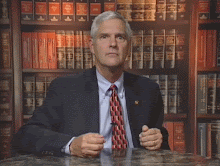
This week I will continue to discuss the recent Freedom Fest convention in Las Vegas, where one of the speakers was Greg Mortenson.
You probably know of Mortenson as the co-author of the book "Three Cups of Tea," which describes his experiences in building about 50 schools for boys — and girls — in mountain villages in Pakistan and Afghanistan. His new book, "Stones into Schools," provides an update on this amazing success.
Mortenson is a fairly shy, humble and self-effacing man who stumbled upon his life's work project that is bringing a measure of peace to those two troubled and unstable lands. As was descending from his attempt to climb K-2, the second highest peak in the world, Mortenson became lost, sick and disoriented, whereupon he was nursed back to health by the people of one of the villages.
In gratitude, Greg promised to come back and build them a school, which he learned, was the most closely held desire of the villagers. Thereafter he kept his promise, and that began his story.
Mortenson does it right by employing the methods I was actually taught during my training for the Peace Corps. He understands that no program will be really successful unless it addresses what we in the Peace Corps called the "felt needs" of the community.
That means that the people in the community must actually want the project, and be materially involved in the decision-making and implementation process. And then the project only has a real chance to become permanent if it will continue to prosper without us.
In that regard, during training we were told the hypothetical story of a Peace Corps Volunteer, who was asked by one of the visiting Peace Corps staff members what he had accomplished during his two years of service.
The volunteer responded by pointing to some people working in a field and growing some drought-resistant grain, which he had introduced into his village, and pointing in another direction to the people working to install a new water treatment plant that he had initiated.
Finally, he pointed to a neighboring house in which a woman was working on her loom. She was doing work for the coop he had helped to start and that weaved native cloth in traditional designs to be sold in the tourist trade. And all of this was happening while he was sitting down and having breakfast.
In his work in building schools in remote mountainous villages, Greg Mortenson considers it essential to take the time to build up relationships with the tribal elders in the communities, listen to them, work with them, and be guided by them.
And he will not build a school unless the village is completely involved by donating the land, the necessary wood and the labor. As a result, none of his schools have been attacked by the Taliban, because the elders have influence and a strong following in their villages, and the Taliban does not want to alienate the villagers.
One example he discussed involved his being approached by the elders from a remote village in Afghanistan that was heavily infiltrated and controlled by the Taliban. Nevertheless, these elders requested that he help build a school in their village. Given the location, Mortenson was naturally skeptical of being able to do this, but he invited the elders to visit a school that he had built about 50 miles from their village.
When these elders met him at the school a few weeks later, they were all dressed in robes and turbans, and each was heavily armed with a machine gun. But, as he tells it in the book, when they saw the playground, the men dropped their guns on the ground and each man started playing on the swings and slides. And it was a sight to behold, with turbans flying in the wind and big smiles all over these stately and (for us) normally terrifying-looking men.
After a full hour and a half, Mortenson told them that it was time to stop playing and to address the issue at hand. So they sat down with him and soon invited him to come to their village to discuss the building of a school. Although it would normally be quite dangerous for a Westerner to go to that area, he later traveled there safely as their guest.
When Greg arrived the village elders unanimously agreed to his terms and requested a school — as long as it would have a playground! Mortenson agreed, but remained humorously concerned that the adults would be using the swings and slides so much that they might not be available for the children.
Before he left the village, Mortenson asked the chief elder (who is almost always the one who has the most silver in his beard) why they so badly wanted a school. The man responded that when he was 12 years old, the Soviets invaded the country.
So he was pulled out of school, and taught to hate and to fight, which he had been doing ever since. Thus he never really had a childhood. But now he not only wanted to make up for his own loss, he also wanted his children to have the childhood and education that he never had.
Our government actively solicits Greg Mortenson's advice, and, as a military veteran, he gives it openly and freely. But he goes out of his way not to accept any money from our government. If he were to do that, he would be seen as an arm or instrument of the government, and that would in effect terminate his effectiveness. And unfortunately, the government does not often follow his advice about developing relationships with the elders in the various villages.
But there is no reason why each of us cannot fight for freedom like Greg Mortenson — each in our own way. Obviously most of us cannot affect an entire world, but we can be effective in the smaller worlds that we do live in. And, like Greg Mortenson, we can begin by listening better to the people around us.
JAMES P. GRAY is a retired judge of the Orange County Superior Court, the author of "A Voter's Handbook: Effective Solutions for America's Problems" (The Forum Press, 2010) and can be contacted at jimpgray@sbcglobal.net or via his website at http://www.judgejimgray.com.
Showing posts with label Freedom Fest. Show all posts
Showing posts with label Freedom Fest. Show all posts
Monday, August 2, 2010


Tuesday, July 20, 2010
Canada has the right idea - by Judge Jim Gray
This past weekend I joined about 2,000 other people at a convention called Freedom Fest in Las Vegas. In many ways it was intensely discouraging. In many other even more important ways, it was encouraging and exhilarating.
The discouraging part dealt with our present economy and the forecasts for the immediate future. Many seemingly knowledgeable people stated forcibly that we cannot have a sustainable economic recovery with such large government spending and deficits and no gain in job creation. At the moment, our government spending is at the rate of about 39% of the gross national product. In addition, this year we are running a deficit of about $1.35 trillion, with estimates that next year it will be three to four times that number.
Simply stated, this government spending will put our economy and probably the world into a depression.
As a result, I came home and sold all of my mutual funds. At the moment they are not a good investment. Our own government underscores that fact, because it is making it increasingly difficult to move our assets out of the country. For decades we looked with disapproval at the governments of Third World countries that had adopted regulations punishing people for moving their assets abroad, but now our government is doing the very same thing. Most discouraging!
Furthermore, we heard that our government is trying to convert our nation's financial advisors and securities brokers into policemen. Under the so-called Patriot Act, which has been heartily embraced by the Obama administration, it is a crime for financial counselors to see something in our financial patterns that "even appears suspicious" without reporting it to the federal authorities. And, according to many of the counselors, this has little to do with terrorism or even drug money laundering, and instead it simply has to do with possible avoidance of taxes. This is the depth to which our government now has fallen.
So in the face of all of this reality, how could I emerge optimistic? Because it was reaffirmed, again and again, that freedom works! The free enterprise system, buttressed by private property rights, a fair and just judicial system for all, and a smaller, less intrusive, and less expensive government, can and will bring us out of these problems! These are what have made our country strong and great throughout our history, and they will do it again!
Canada is a magnificent example of this. Most of us think of Canada as being socialist, and it certainly still is in its health-care system. Furthermore Canada richly deserved that label in its entirety until the late 1990s. Between 1976 and 1995, the percentage of Canada's deficits went up from 35% to a full 78% of its GNP, government spending reached up to 53% of the nation's GNP, and welfare payments increased from 5% of the budget in 1980 to 10% in 1991. So all of this resulted in the Wall Street Journal running an article Jan. 12, 1995, that called Canada an honorary member of the Third World because of the weakness of (what the newspaper called) the Canadian Peso.
The article triggered enormous reforms in Canada. In view of the reality that one-third of every dollar paid in taxes was being spent simply on interest payments on the national deficit, concerned citizens and the media went over the heads of the politicians and sent their message directly to the people that the deficits must be strongly reduced. And the best way to accomplish this was to reduce government spending, and to stimulate the economy by reducing taxes. The people listened and responded.
As a result of pressure for these basic changes from the voters, within a few years all of the political parties in Canada were in favor of reducing the deficit — including the Liberal Party and the Socialist Party! The only debates were what spending and which taxes to reduce — and how much. Thus, since 1997 the federal workforce has been reduced by 14%, and all taxes have been reduced as well, including income, sales, capital gains and estate taxes. This combination of actions has reduced the spending of the Canadian government from 53% to about 39.7% in 2008. Our level is about 39%, but estimates are that by two years from now ours will be even higher, and theirs even lower.
Contrary to the warnings of the critics, even though government spending and taxes were materially reduced, government revenues remained the same. As a result, Canada now has one of the strongest economies in the world. The recession we have experienced in our country was appreciably milder and shorter in Canada, its job market has been strong, and its real estate has held its value. Canada's fiscal deficit for this year is projected to be about $33 billion, which, at less than 3% of its GDP, is considered manageable. On the other hand, our estimated federal deficit is $1.35 trillion, or about 9.2% of our GDP. But nevertheless there was much optimism at Freedom Fest because we know we can learn from our mistakes and from Canada's example, and we can turn things around by returning to our roots.
So basically we have two choices: We can either view these present circumstances with despair, or we can view them as a challenge. Most of the participants at the conference were not really worried about our future because throughout our history Americans have always risen to a challenge. In other words, all we need to do to regain our strength and our dreams is simply to repress our self-pitying and resentful sides, and return to being Americans. And I know that we will!
JAMES P. GRAY is a retired judge of the Orange County Superior Court, the author of "Wearing the Robe: the Art and Responsibility of Judging in Today's Courts" (Square One Publishers, 2010), Why Our Drug Laws Have Failed and What We Can Do About It, A Voter's Handbook, Effective Solutions To America's Problems and can be reached at jimpgray@sbcglobal.net or http://www.judgejimgray.com. Judge Jim Gray is also currently offering his 25 years of experience on the bench to ADR Services in Orange County for Arbitration and Mediation services.
The discouraging part dealt with our present economy and the forecasts for the immediate future. Many seemingly knowledgeable people stated forcibly that we cannot have a sustainable economic recovery with such large government spending and deficits and no gain in job creation. At the moment, our government spending is at the rate of about 39% of the gross national product. In addition, this year we are running a deficit of about $1.35 trillion, with estimates that next year it will be three to four times that number.
Simply stated, this government spending will put our economy and probably the world into a depression.
As a result, I came home and sold all of my mutual funds. At the moment they are not a good investment. Our own government underscores that fact, because it is making it increasingly difficult to move our assets out of the country. For decades we looked with disapproval at the governments of Third World countries that had adopted regulations punishing people for moving their assets abroad, but now our government is doing the very same thing. Most discouraging!
Furthermore, we heard that our government is trying to convert our nation's financial advisors and securities brokers into policemen. Under the so-called Patriot Act, which has been heartily embraced by the Obama administration, it is a crime for financial counselors to see something in our financial patterns that "even appears suspicious" without reporting it to the federal authorities. And, according to many of the counselors, this has little to do with terrorism or even drug money laundering, and instead it simply has to do with possible avoidance of taxes. This is the depth to which our government now has fallen.
So in the face of all of this reality, how could I emerge optimistic? Because it was reaffirmed, again and again, that freedom works! The free enterprise system, buttressed by private property rights, a fair and just judicial system for all, and a smaller, less intrusive, and less expensive government, can and will bring us out of these problems! These are what have made our country strong and great throughout our history, and they will do it again!
Canada is a magnificent example of this. Most of us think of Canada as being socialist, and it certainly still is in its health-care system. Furthermore Canada richly deserved that label in its entirety until the late 1990s. Between 1976 and 1995, the percentage of Canada's deficits went up from 35% to a full 78% of its GNP, government spending reached up to 53% of the nation's GNP, and welfare payments increased from 5% of the budget in 1980 to 10% in 1991. So all of this resulted in the Wall Street Journal running an article Jan. 12, 1995, that called Canada an honorary member of the Third World because of the weakness of (what the newspaper called) the Canadian Peso.
The article triggered enormous reforms in Canada. In view of the reality that one-third of every dollar paid in taxes was being spent simply on interest payments on the national deficit, concerned citizens and the media went over the heads of the politicians and sent their message directly to the people that the deficits must be strongly reduced. And the best way to accomplish this was to reduce government spending, and to stimulate the economy by reducing taxes. The people listened and responded.
As a result of pressure for these basic changes from the voters, within a few years all of the political parties in Canada were in favor of reducing the deficit — including the Liberal Party and the Socialist Party! The only debates were what spending and which taxes to reduce — and how much. Thus, since 1997 the federal workforce has been reduced by 14%, and all taxes have been reduced as well, including income, sales, capital gains and estate taxes. This combination of actions has reduced the spending of the Canadian government from 53% to about 39.7% in 2008. Our level is about 39%, but estimates are that by two years from now ours will be even higher, and theirs even lower.
Contrary to the warnings of the critics, even though government spending and taxes were materially reduced, government revenues remained the same. As a result, Canada now has one of the strongest economies in the world. The recession we have experienced in our country was appreciably milder and shorter in Canada, its job market has been strong, and its real estate has held its value. Canada's fiscal deficit for this year is projected to be about $33 billion, which, at less than 3% of its GDP, is considered manageable. On the other hand, our estimated federal deficit is $1.35 trillion, or about 9.2% of our GDP. But nevertheless there was much optimism at Freedom Fest because we know we can learn from our mistakes and from Canada's example, and we can turn things around by returning to our roots.
So basically we have two choices: We can either view these present circumstances with despair, or we can view them as a challenge. Most of the participants at the conference were not really worried about our future because throughout our history Americans have always risen to a challenge. In other words, all we need to do to regain our strength and our dreams is simply to repress our self-pitying and resentful sides, and return to being Americans. And I know that we will!
JAMES P. GRAY is a retired judge of the Orange County Superior Court, the author of "Wearing the Robe: the Art and Responsibility of Judging in Today's Courts" (Square One Publishers, 2010), Why Our Drug Laws Have Failed and What We Can Do About It, A Voter's Handbook, Effective Solutions To America's Problems and can be reached at jimpgray@sbcglobal.net or http://www.judgejimgray.com. Judge Jim Gray is also currently offering his 25 years of experience on the bench to ADR Services in Orange County for Arbitration and Mediation services.
Subscribe to:
Posts (Atom)

+a.jpg)